Police Violent Take Down Teen Again
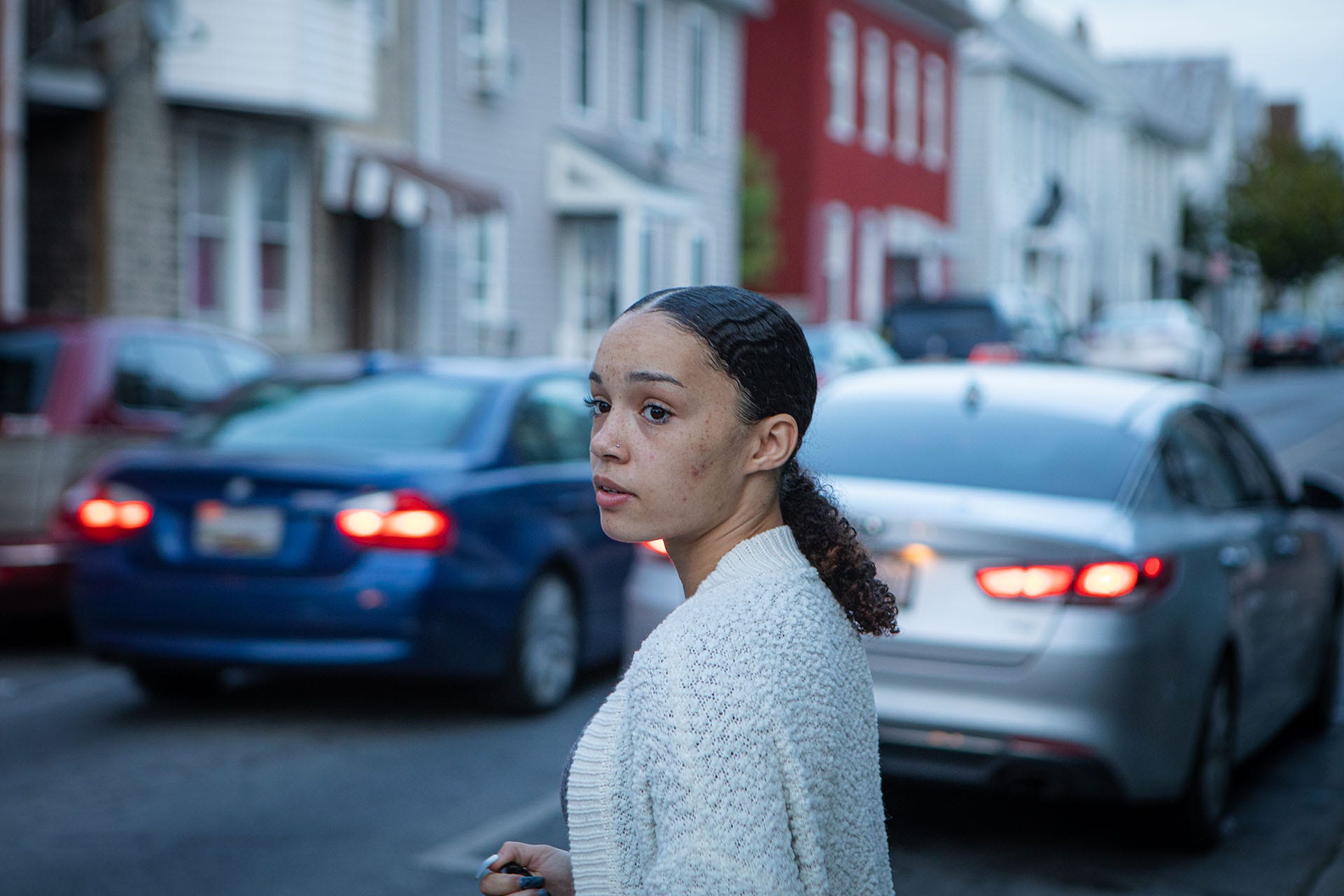
HAGERSTOWN, Md. — On a warm September Sun in 2016, a minor Black teenager in a pinkish T-shirt biked through narrow city streets and rolled into an intersection. So did a Chevy Cruze, driven by an 85-year-old man heading habitation from church.
The next thing 15-year-old Brianna Stuart knew, she was lying dazed on the pavement, she said in an interview. The driver alerted 911 near the accident.
Her mom would be so mad at her, she thought. Her parents had warned her never to talk to police without them in this majority-white community – and told her not to bike in this function of boondocks.
She cursed at officers trying to question her and climbed back on her Huffy.
This article was published in partnership with The Marshall Project, a nonprofit news organization covering the U.Due south. criminal justice system. Sign up for their newsletter, or follow The Marshall Projection on Facebook or Twitter.
White officers pulled the 100-pound girl off her wheel by her backpack straps, a police force body photographic camera video shows. As she struggled to get away, they shoved her confronting a building and locked her wrists into cuffs while she sobbed and cursed and screamed.
"You allow that badge get to your head," a bystander chosen out.
The police carried the increasingly hysterical teen to a patrol machine, but she refused to put her feet inside, the video shows. The constabulary on the scene lost patience.
"I'll spray her," one said.
He waved the pepper spray toward her face, and so pushed down on the canister. Information technology hissed, twice. Stuart shrieked and cried out, "I tin can't breathe!" She continued to wail as the officers milled around outside the car.
The constabulary department said its officers handled the state of affairs correctly. Simply bystander video – of a kid's bike accident that escalated out of command – spread on social media.
The incident echoes like scenes across the country: A 9-twelvemonth-old daughter in Rochester, New York, pepper sprayed as she sat in handcuffs in the back of a patrol car, crying for her dad. A teenage daughter at a Texas pool party, wrestled to the footing by an officeholder. An Iowa teen, pepper sprayed past police as she waited for the motorbus after school. All were Black.
Police handcuffed and pepper sprayed this 9-twelvemonth-sometime Black girl in Rochester, New York
Trunk cam footage shows police restraining a 9-year-old daughter, who was handcuffed and sprayed with pepper spray and told, 'Yous did it to yourself, hun.'
USA TODAY, Storyful
Black youths make up the majority of kids on the receiving stop of law violence – and a striking number of them are girls, an investigation by The Marshall Project found.
There is no comprehensive national database of tearing interactions between constabulary and civilians. Only when we looked at data for six big police departments that provided detailed demographic data on employ-of-force incidents, nosotros found nearly four,000 youngsters 17 and under experienced police violence from 2015 through 2020.
Virtually 800 of the children and teens – roughly a fifth of the full – were Black girls. White girls were involved in about 120 cases, representing only 3% of use-of-force incidents involving minors.
Equally Black communities are painfully aware, and researchers take detailed, Black boys bear the burden of police violence against minors. That was true in our information, too. More than ii,200 Blackness boys were involved in apply-of-force incidents in the 6 cities we examined.
Only Black girls also accounted for a significant share of the cases. In New Orleans, every girl in apply-of-force information was Black; two-thirds of the girls who live in the city are Blackness. A spokesman for the police department emphasized that all but 1 of the incidents "involved lower levels of force (Hands, Takedown, Firearm Pointing, etc.)."
The story was similar in Chicago, Minneapolis, Indianapolis, Columbus, Ohio, and Portland, Oregon, where girls who experienced force by police force were disproportionately and often overwhelmingly Black. Several of these departments declined to annotate.
Simply the Indianapolis Metropolitan Police Department said that Black girls take more than frequent contacts with officers, every bit both suspects and victims of crimes, which may explain why they also experience law force more often than other girls.
"Those numbers are concerning, but the statistics lone present a misleading moving-picture show," said spokesman Lt. Shane Foley. The section continues "to work towards addressing inequities in the community."
Portland police force said the utilise-of-strength statistics on Blackness girls are in line with the proportion of Black people arrested in the city.
In Chicago, "sanctity of life is the highest priority" of the police force department, a spokesman wrote in a statement.
A 2017 report past the Georgetown Law Center on Poverty and Inequality found that adults often see Black girls as older and less innocent than white girls of the same age.
"Our deeply embedded biases about Black children beingness unsafe applies both to boys and girls, and I think nosotros forget that," said Kristin Henning, a Georgetown Police professor. "We wouldn't fifty-fifty think about stopping a white girl in quite the way we stop a Black daughter."
When police force use force confronting civilians, just a small-scale proportion of incidents end with a trip to the emergency room, experts say. All the same, in California, almost xvi,000 children and teens went to the hospital after interacting with police force enforcement betwixt 2005 and 2017, co-ordinate to an analysis published in September by researchers from the University of California, Berkeley.
Black girls age 15 to 19 were four times equally probable as white girls to exist hurt.
The findings "highlight the means in which Black girls are uniquely harmed by policing," co-ordinate to Kriszta Farkas, one of the study'south authors. "The protections of babyhood are not afforded to all children."
Reporters at The Marshall Project examined dozens of individual cases in which constabulary officers used force on Black girls. Many of the incidents started small: an allegation of a teenager throwing candy at a store clerk, a teen who skipped schoolhouse because she was feeling stressed out, a group of girls pond at a condo complex's pool.
These situations escalated when a daughter talked back to an officer or did not immediately follow instructions. In some cases, police body-slammed teens to the basis, punched them, used Tasers or pointed guns at girls. None of these teenagers was armed.
Information technology's hard to say how representative these incidents are. Express national data on law employ of force against minors comes from the federal Centers for Affliction Control and Prevention. It estimates that emergency rooms nationwide treated 21,000 people under the age of 18 for nonfatal injuries at the easily of law and security guards from 2015 through 2019. More 7,000 of them, or about 33%, were Black youth, even though they business relationship for just xiii% of children in America.
This data, which represents merely a fraction of total forcefulness cases, doesn't give details about the incidents, including how severe the injuries were. Many of the nation's 18,000 police agencies don't track that information either, and criminal court records are often sealed in cases involving juveniles.
In the vi cities that provided enough data for us to analyze, police force against children and teens made up 10% of all cases. Incidents involving girls were even less mutual – virtually two% of full cases.
Merely the effects on girls were profound, they and their families told us, describing nightmares, fear of leaving the house and distrust of police. "These encounters have lasting traumatic effects that can shape life decisions and beliefs," said Craig Futterman, a law professor at the University of Chicago.
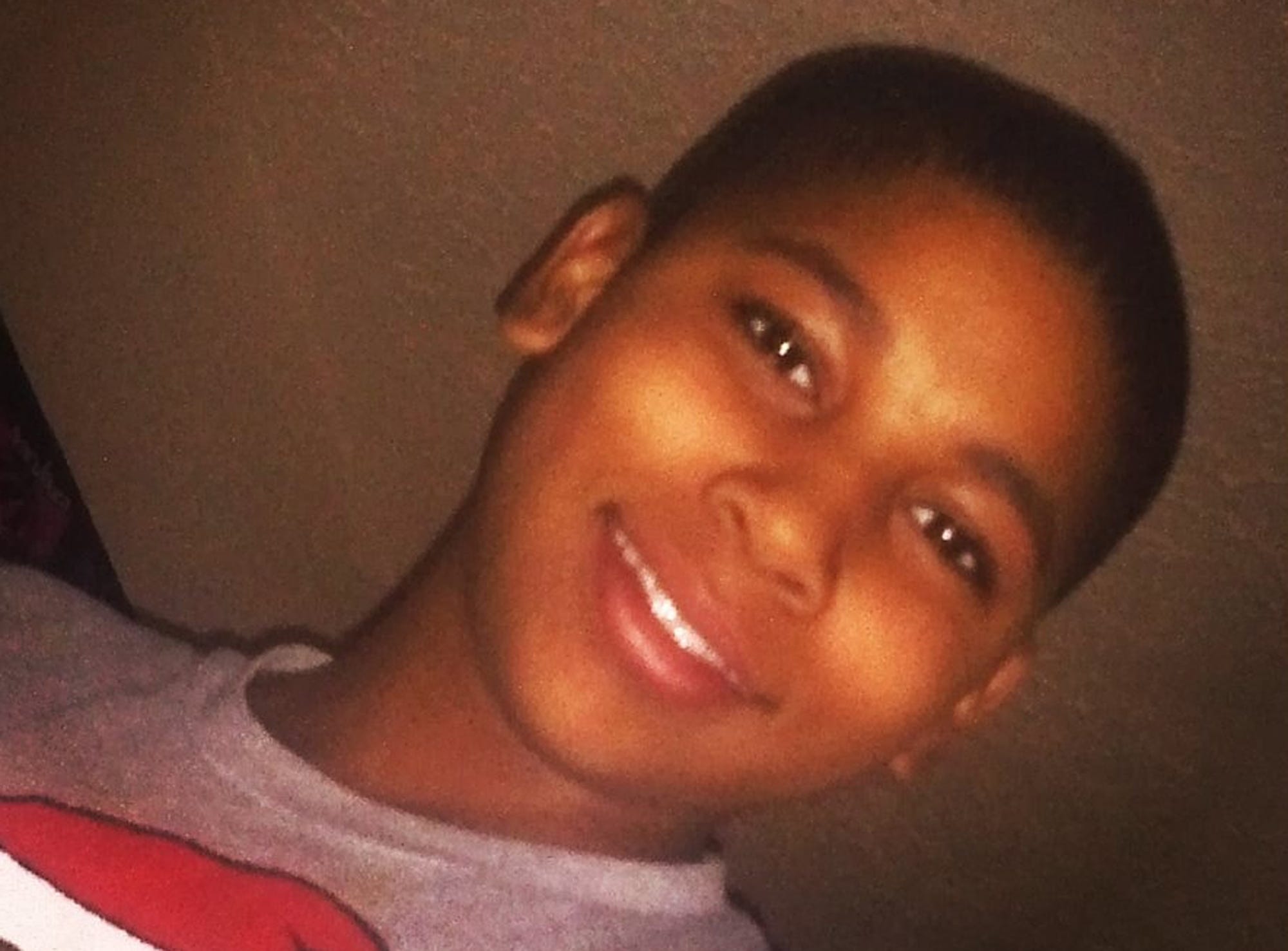
Few departments take specific policies governing interactions between officers and youth, we found. One of the rare ones that does is Cleveland, which took more than than five years to enact guidelines after police killed 12-yr-old Tamir Rice. That department'southward new youth policy requires, for example, that officers utilize age-advisable language.
Many law enforcement experts say police have few good options when it comes to dealing with youth, particularly in cases that involve teens who are fighting or threatening others. Teenagers, they annotation, can be as large equally officers and may conduct weapons.
Age is only ane of many factors police force must consider when they assess threats, said David Thomas, a professor at Florida Gulf Declension University and a old member of the police department in Gainesville, Florida. "How many officers are there? How many subjects are there? What is the summit and trunk weight?"
And likewise, he added, "What do you desire me to practice to command them?"

The mode Stuart remembers it, she couldn't calm down. And the more officers told her to, the worse she felt, she told The Marshall Project.
Later on the officer pepper sprayed her, law drove her to the station. Her parents picked her up and took her to a medical center. She had cuts, a possible concussion, a burning feeling on her confront, and pain in her hip, neck, shoulder, lower back and abdomen, according to a complaint she filed in court.
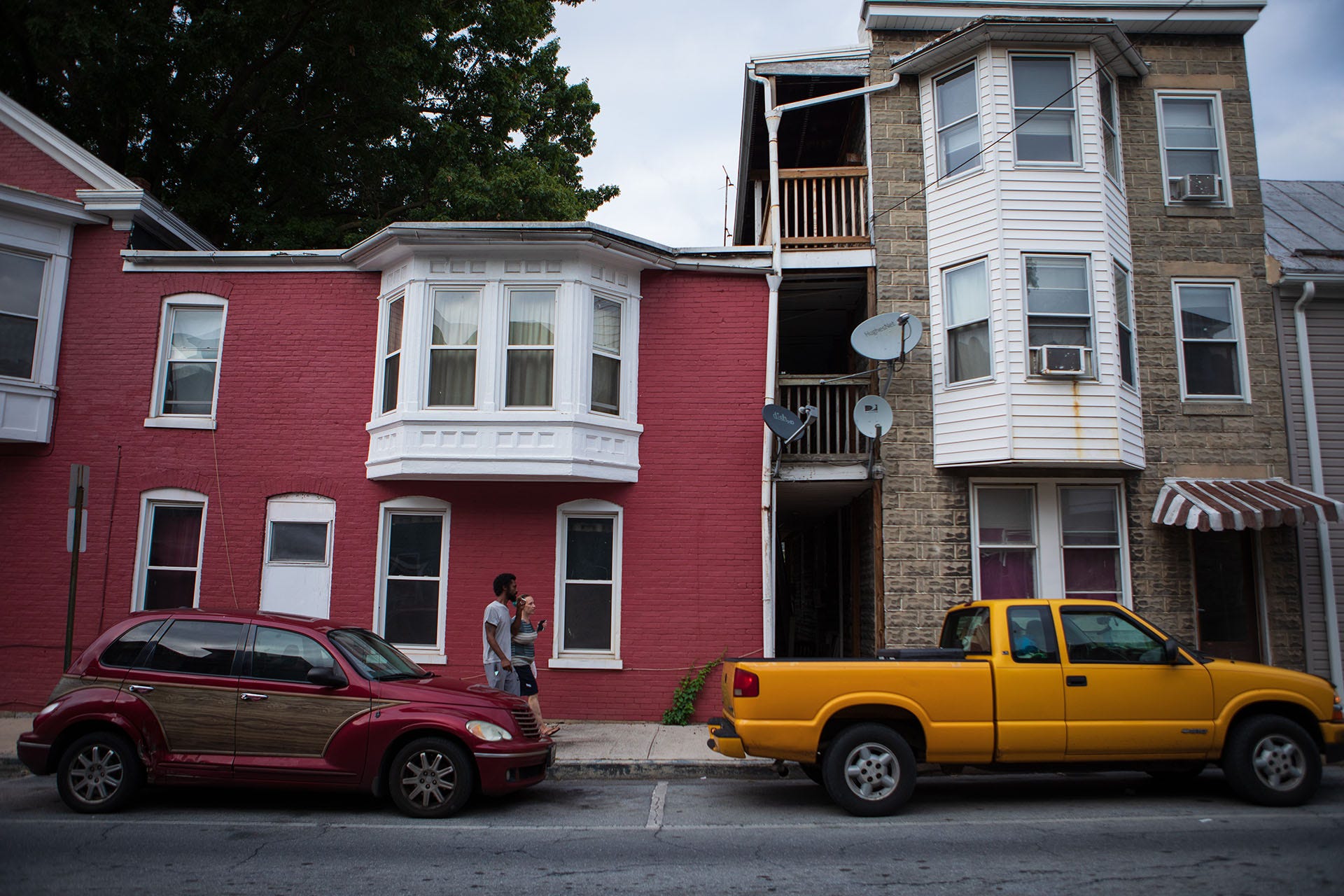
The viral video of the officeholder spraying her shone a spotlight on Hagerstown, a city of 40,000 about 75 miles northwest of Baltimore.
In its heyday, the city was a manufacturing centre for everything from airplanes to pipage organs. But in contempo years, it has been so ravaged by opioids that public memorials to overdose victims dot the downtown.
Newspaper accounts describe decades of racial tension in Hagerstown, including a white oversupply at a baseball game refusing to clap for Willie Mays in 1950 and a quondam city police officer convicted in 2007 of making racist threats.
Days afterward the incident, Stuart and the police department held competing printing conferences.
Stuart stood before a group of reporters and read from a prepared statement describing the accident and accusing the police of mistreatment.
Hagerstown'southward constabulary chief at the time, Victor Brito, told reporters that the officers had acted properly. Law had to detain Stuart because she'd been "assaultive" when they tried to question her about the blow, he said, and officers used an "appropriate amount of forcefulness."
Police announced that Stuart would face up charges including disorderly conduct, 2 counts of second-degree assail for kicking officers and failure to obey a traffic light.
She eventually wrote an apology to officers for cursing during the encounter, and all charges were dropped.
Her female parent, Christina Stuart, said she doesn't condone her daughter's language with the officers – but that doesn't excuse their actions.
"I feel that they did everything wrong," she said. "The style they manhandled her was absolutely ridiculous."
Christina Stuart, who is white, confirmed that she has told her children non to talk to constabulary without her: "Officers talk to me different."
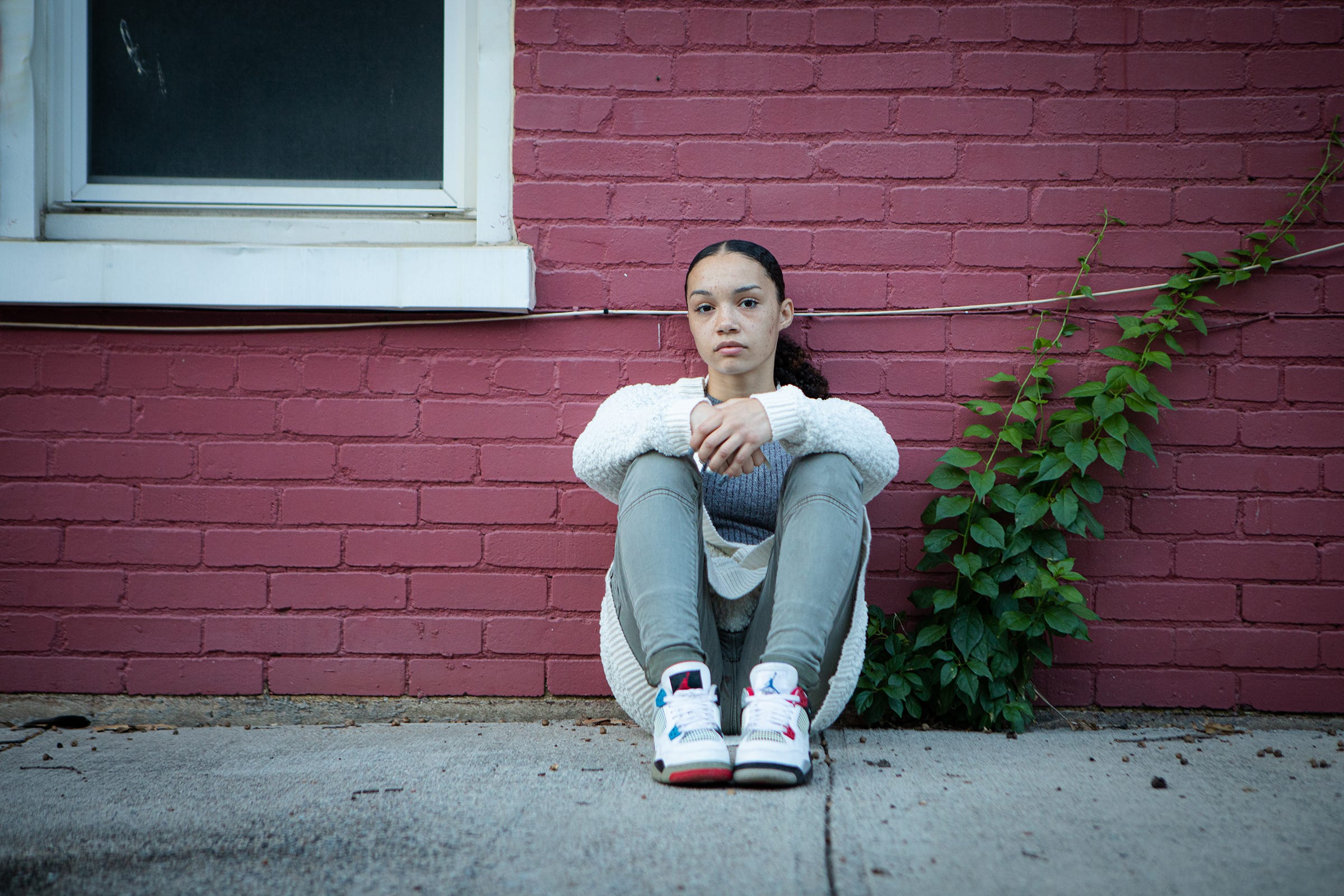
For Brianna Stuart, it was impossible to return to normal life.
Before the incident, she had hoped for a college soccer scholarship. Afterwards, she felt that other students stared at her in the hallways, she said. She quit the soccer squad.
In 2017, she sued the constabulary and urban center for violating her civil rights. In its legal response, the city said officers had been justified in using force considering she went on a "shrill and profane tirade and tried to trip and kick the officers." But the urban center settled in 2019, paying her $40,000, according to urban center records.
"The Urban center has non acknowledged any wrongdoing and supports all of its police enforcement officers," Wes Decker, a spokesman for Hagerstown, wrote in a joint statement from the city and police department. "All of our officers piece of work hard to protect and serve the citizens of Hagerstown."
The officers named in the lawsuit did not reply to email requests for annotate. Brito, who is at present the constabulary chief in Rockville, Maryland, referred all questions to Hagerstown police.
A few police departments accept started training officers to handle children and teenagers differently from adults.
Lt. Shelly Katkowski is the preparation director for the constabulary section in Burlington, a urban center in central North Carolina. She focuses on teaching communication and critical thinking skills, she said, calculation that many new recruits have been taught to come across anybody as a threat.
"There are so many things that we deal with that really have nada to do with crime," she said. "It's really challenging for some of these officers who accept non had a lot of life experience."
Strategies for Youth, a nonprofit aimed at improving interactions between law enforcement and young people, said it has trained officers in more than 20 states nearly developmental differences between teens and adults. Officers acquire to recognize signs of trauma, to speak slowly and to ask questions like, "What would be helpful to yous?" said Lisa H. Thurau, the group's executive director.
"You have to treat kids differently," she said. "If we empathise that at the cognitive level, how come we're not changing the policies?"
After Stuart graduated from high schoolhouse in May 2018, she enlisted in the U.South. Regular army. She made it through kick camp simply said she failed a medical exam considering of hip issues.
By the fall of 2019, she establish herself back home, living with her parents, who work for a tow truck business.
She said she withal feels under a microscope in her hometown. "When I do become to the store, I become people staring at me," Stuart said. "I don't know how to handle that sometimes, so I only try to avoid information technology as much as possible.
"I run across a police officer – a police force officer only minding his business concern – and just instantly start trembling."
She has struggled with relationships, she said. In 2019, officers arrested her after an altercation with a boyfriend. Police accused her of going over to his house and striking him in the head with a knife. The extent of his injuries is not clear from court records, but prosecutors dropped felony charges. Stuart pleaded guilty to misdemeanor assault and served a year of unsupervised probation.
Stuart said she decided to speak publicly most her experiences in hopes that no other immature people would go through the same thing. When she watched the viral video of police pepper spraying the 9-year-old in Rochester, Stuart said, she felt kinship and sadness.
"Same matter that happened to me happened to her, same verbal thing," she said. "It broke my heart."
Wendy Ruderman and Joseph Neff of The Marshall Project and Andrew Fan and Sam Stecklow of The Invisible Establish contributed reporting.
Source: https://www.usatoday.com/in-depth/news/investigations/2021/11/02/police-hurt-many-teens-each-year-alarming-number-black-girls/8557960002/
0 Response to "Police Violent Take Down Teen Again"
إرسال تعليق